
Nouvelle Vague (12A)
-
Fri 30 Jan15:25Past event 17:40Past event
-
Sat 31 Jan12:50Past event 20:30Past event
-
Sun 1 Feb12:40Past event 17:30Past event
-
Mon 2 Feb12:35Past event CAP 17:40Past event
-
Tue 3 Feb15:50Past event CAP, Relaxed 20:40Past event
-
Wed 4 Feb12:50Past event 20:35Past event
-
Thu 5 Feb12:45Past event 20:30Past event CAP
-
Fri 6 Feb15:20Past event 20:30Past event
-
Sat 7 Feb12:55Past event 17:50Past event
-
Sun 8 Feb12:40Past event CAP 17:45Past event
-
Mon 9 Feb15:00Past event 20:30Past event CAP
-
Tue 10 Feb12:55Past event 17:55Past event
-
Wed 11 Feb15:30Past event 20:30Past event
-
Thu 12 Feb15:20Past event 20:35Past event
-
Fri 13 Feb20:20Past event
-
Sat 14 Feb20:20Past event
-
Sun 15 Feb17:25Past event
-
Mon 16 Feb13:00Past event
-
Tue 17 Feb15:35Past event
-
Wed 18 Feb15:00Past event CAP
-
Thu 19 Feb12:40Past event
-
Fri 20 Feb12:40Past event CAP
-
Thu 26 Feb17:25Past event
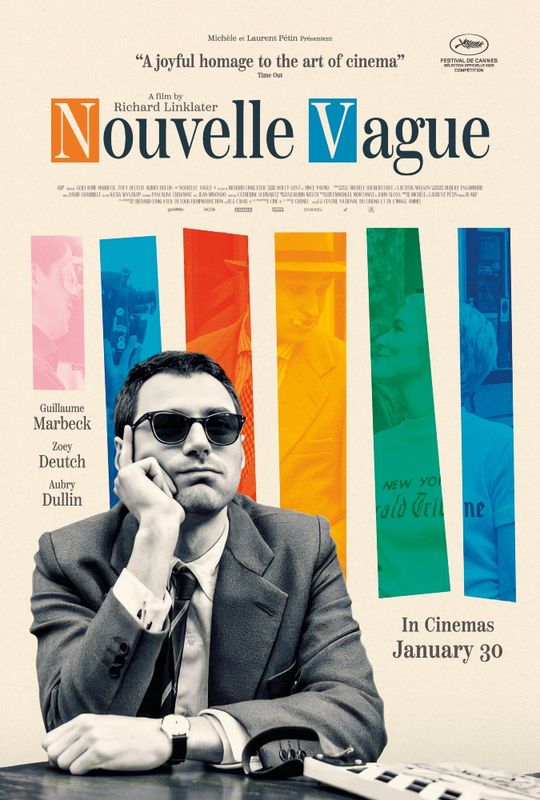
Nouvelle Vague is Richard Linklater’s love letter to the spellbinding magic of French cinema, reimagining the making of Jean-Luc Godard’s revolutionary Breathless, which ultimately cemented Godard as a pioneer of the French New Wave.
As critic-turned-director Godard makes and breaks the rules, a mix of fresh faces and daring talents - including Zoey Deutch as Jean Seberg, Aubry Dullin as Jean-Paul Belmondo, and Guillaume Marbeck as Godard himself - bring his spontaneous, electric film to life.
Capturing the youthful dynamism and creative chaos at the heart of one of the world’s most beloved and influential movies, Nouvelle Vague transports us to the streets of 1959 Paris for an ode to the power of cinema to transform our lives.
Nominated for Best Motion Picture - Musical or Comedy at the Golden Globes.
Breathless screens as part of our French New Wave season which runs 25 Jan - 18 Feb.
Godard's Bande à part also screens, and we have a rare chance to see cult favourite Who Are You, Polly Maggoo? on the big screen.
“If you love film, cinema, and the dreamers who create it this one will simply take your breath away”
Deadline
“Made to inspire young artists to break the rules”
LA Times
An Act of Love
by writer and director Richard Linklater
I once said that any filmmaker who has been working for a while should, at some point in their career, make a film about the process of making a film. It’s only natural to want to explore this complex and all-consuming subject to which we dedicate our passion and creativity. But what is the right approach? How do you find the right tone? Is it even possible to do better than ‘‘Day for Night’’? Probably not.
Over the years, my thoughts always brought me back to the moment I made my first bigger film—to that absolute joy of finally being able to condense years of cinematic ideas and obsessions into a movie. It’s an experience you can only live once, of course. No one is ever truly prepared for the physical and mental battles that come with it: the clash between overwhelming confidence and deep insecurity due to inexperience, the boundless passion that is tested daily by the instability of a job involving so many people, each with their own personalities and needs.
I had my subject, but autobiography didn’t seem like the answer. The struggles of making a film are universal to the artist’s journey, but does the world really need another portrait of an artist wrestling with the torment of creation? Is it even possible to do better than ‘‘8 1/2‘‘?
When Jean-Luc Godard passed away two years ago, I thought to myself: “It’s time to make this film, this portrait of that singular moment—the birth of the New Wave”. This love letter to those who made you want to make films, who made you believe you could make films, who convinced you that you should make films—and, by the way, what were you waiting for?
As far as I’m concerned, the French New Wave changed my life. I had just moved to a big city. I was 20 years old and still imagining myself a future novelist or playwright. To me, cinema was Hollywood. I liked films well enough, but I had never considered making movies myself.
When I saw ‘‘Breathless’’ and other New Wave movies, I thought: “So, it’s possible?” That freedom fascinated me. I didn’t know anything about filmmaking, but I could feel how cool, joyful, and revolutionary the movie was. A short time later, when they heard I was now interested in cinema, a friend of my parents loaned me their book about the New Wave.
That era of cinema has remained fundamental to me. And no one embodies it better than Godard. He does what’s forbidden, he sketches, he improvises. I love his humor, his physicality, his audacity. He follows no rules but his own cinematic consciousness.
When he makes his first feature, he is lagging behind his friends from Cahiers du Cinéma. He is worried, anxious, afraid he has missed the wave. He lacks confidence. I find that very endearing and nothing like the way people will imagine him later in his career.
From where we stand today “Breathless” is at the midpoint of cinema history. It now seemed like the perfect moment to experience the radical and daring act that this film represented. To remind ourselves that cinema is eternally capable of reinventing itself. To paint a playful portrait of a tight-knit community of film fanatics who live, eat, and breathe cinema. To show that cinema is—and will always be—an inventive medium. To explore how a new kind of personal filmmaking comes to life.
For the illusion to be complete, we needed to find actors who resembled their real-life counterparts and were unknown, so as not to break the spell of hopefully feeling that we are truly with Godard and his contemporaries. And, of course, we had to find someone who could embody this bold, tormented, fragile, and arrogant young filmmaker.
The casting process took more than six months. When I first brought together our Godard, our Truffaut, our Chabrol and our Schiffman, it was the decisive moment. It’s when I realized this film could work as I wanted, because they were right there in front of me and happy to be back together in 1959. Another crucial step: rehearsals with the actors and on the film’s locations and sets.
Before we started, I gave them this text to read: “Godard was going for a spontaneity, an immediacy, as were many painters and jazz musicians of the time. The notion of ‘improvisation’ was in the air, the epitome of cool. To achieve that kind of freedom, you either have to be spontaneously brilliant (good luck with that!) or work incredibly hard, fully examine each scene from every angle, know it so well, and being so relaxed with what we’re doing that it seems spontaneous and improvised, that the performance is without artifice.
Once you get past the lines themselves, the intentions of the scene, you can find another level of reality, where your full self can be revealed within the character. You must be so aligned with your character and those around you that all behavior, attitude, gestures and relations will be authentic.
Important: You are not acting in a ‘period film.’ This film does not carry any particular significance because of its age or reputation. The moments we’re creating, the characters involved haven’t earned any of that yet. As an actor you can only do what any of us can do going through life, simply live in your moment, with the excitement and optimism that come with youth and making art. Much of the underlying humour comes from the fact that our audience already knows the outcome.
We are making them witnesses to the emergence of a singular cinematic artist, making one of the most talked-about and influential films in history.
But nobody in our film knows this. There are only a few conflicts—namely with Beauregard, when it comes to schedule and money, and Seberg, to whatever degrees when it comes to working methodologies. But for the most part, you are all just happy to go along for the ride, and you have no idea if what you’re working on is any good or not...
Never forget that filmmaking itself is optimistic. And, as François Truffaut said at this time: ‘The film of the future will be an act of love.’
So now… let’s rock and roll!”
- Director
- Richard Linklater
- Cast
- Guillaume Marbeck, Aubry Dullin, Zoey Deutch
- Duration
- 106 min
- Opening
- Fri 30 Jan
- Year
- 2026
- Country
- United States
- Language
- English
Certificate: 12A
An enchanting ode to the rapture of cinema