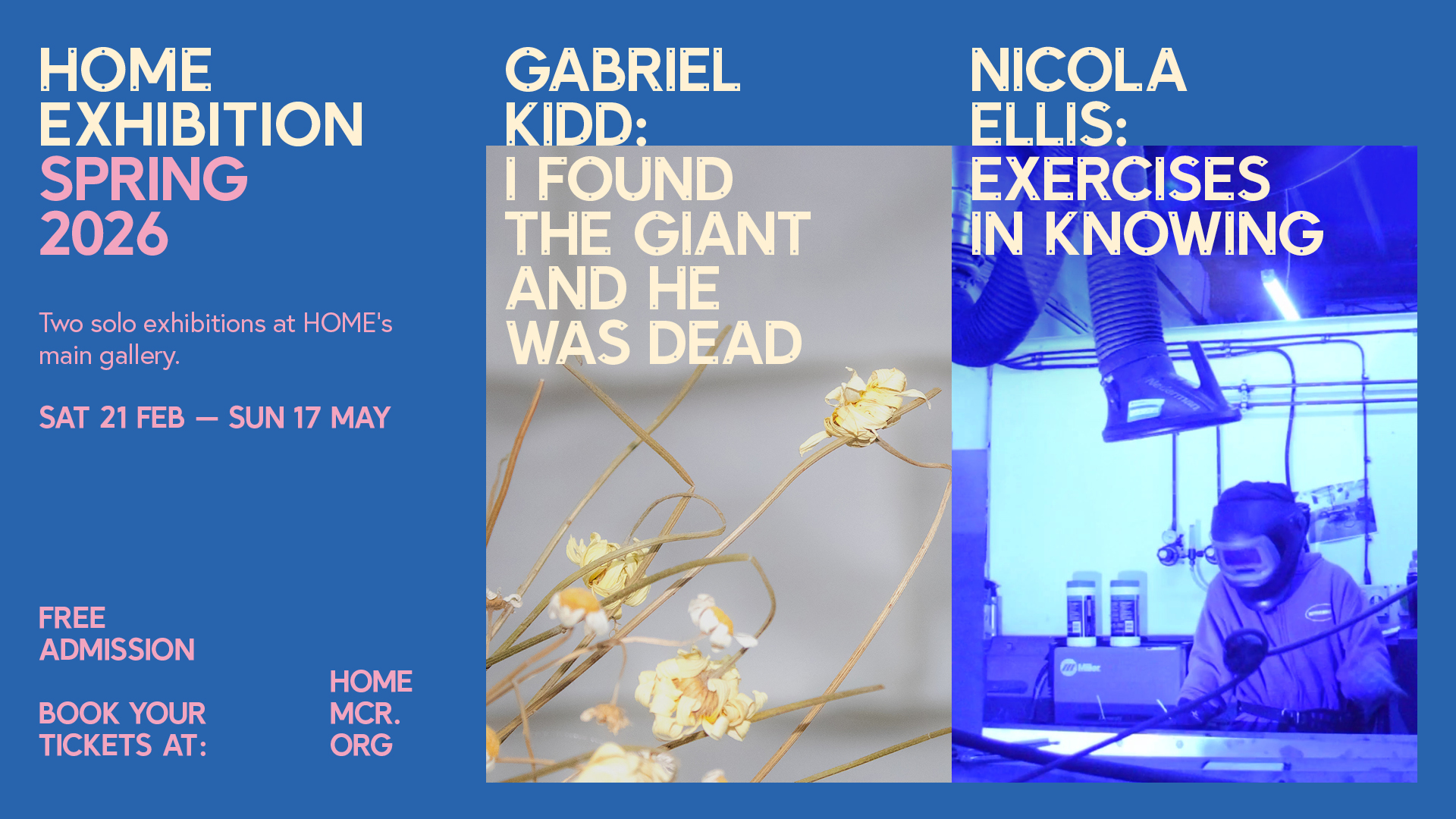

HOME Main Gallery Spring Exhibitions
Nicola Ellis: Exercises in Knowing and Gabriel Kidd: I found the giant and he was dead
Exhibition Dates: Sat 21 Feb – 17 May 2026
Public preview: Fri 20 Feb, 18:00 - 21:00
- Two new large-scale sculpture exhibitions will be unveiled at HOME’s main gallery in February 2026.
- Artists Nicola Ellis and Gabriel Kidd have exhibited across the UK and Europe.
- Nicola Ellis is creating three new bodies of work for Exercises in Knowing.
- Gabriel Kidd brings together sculpture, drawing, sound, and writing for I found the giant and he was dead.
HOME is thrilled to announce its forthcoming double solo exhibition opening this Spring from Sat 21 Feb to 17 May 2026. Two stunning solo exhibitions of new large-scale sculpture by Nicola Ellis: Exercises in Knowing and Gabriel Kidd: I found the giant and he was dead, celebrate the work of two outstanding North-West based artists. Both practices express a reverence for materiality, the processes of production, natural evolution, and our cultural and social relationships to them.
Nicola Ellis: Exercises in Knowing
Nicola Ellis is a Northwest–based artist whose work has been exhibited across the UK and Europe.
Ellis’ work is often created in response to contexts outside of traditional art environments, using discarded or overlooked materials, substances or subjects within industrial or scientific contexts. By combining sculpted, found and digitally manipulated materials, she creates forms that retain the traces of their origins exploring their ecologies and legacies.
For this exhibition at HOME, Exercises in Knowing, Ellis will create three new bodies of work that extend her ongoing collaboration with the steel enclosure manufacturer Ritherdon & Co in Darwen, Lancashire. This work explores how we relate to industry, materials, and labour, highlighting the role of sensory and tacit knowledge in these relationships, as well as the ways such knowledge is communicated.
Subject to use is a series of sculptures made from plaster of Paris featuring fabricators carrying out gestures or actions performed daily. Worked into plinths, the gestured limbs coordinate to apply personal protective equipment, drive a forklift, or lift steel components. These works become studies of hands interacting with tools or machines, displaying the dexterity and control, immortalised into plaster evoking classical sculpture, and statue.
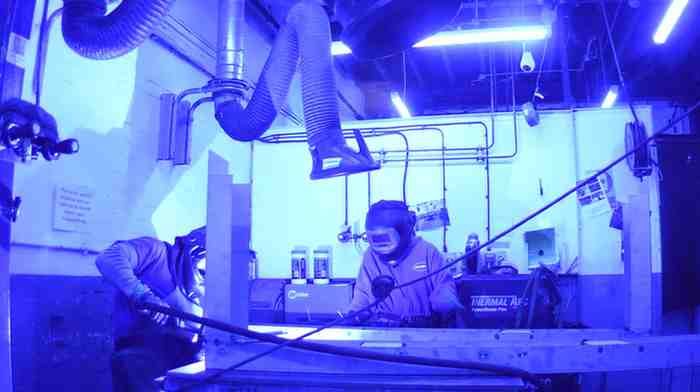
The video work Arc is a split screen work shot from nine angles around the welding booth at Ritherdon using an array of digital cameras. Within the heat of the confined space and the intense UV light, the routine, technical skills and knowledge accumulated by the fabricators are apparent, accompanied by sounds from the booth and live radio vibrations.
Retro activity series: residual architecture is a series of large works suspended throughout the space, flat, almost paper-like sheets of steel with punched out voids which act as an angular oculus through which to view the other works in the exhibition. Reclaimed recyclable waste materials from the Ritherdon manufacturing line – they are the skeletal remains of steel sheets used to produce casing for EV street chargers and similar steel enclosures which house the street-side electrical units that power outdoor street lighting, traffic lights, smart motorways and more.
The handling of tools—acquired not through manuals but over years of observation, practice, and repetition—is a source of familial connection for Ellis. This work expresses a deep reverence for skills usually hidden behind factory walls and now—often assumed to be automated. Over the last 30 years, the UK’s manufacturing sector has declined, and the economy has shifted toward services, this reflects a structural shift rather than a contraction of output, as services have expanded much more rapidly than manufacturing has shrunk. This exhibition celebrates the communities still centred around manufacturing and manual making, highlights our symbiotic relationship with materials and tools, and emphasises the value of doing things by hand—even within a digitally organised system—reminding us that people remain central to creating the infrastructure that surrounds us.
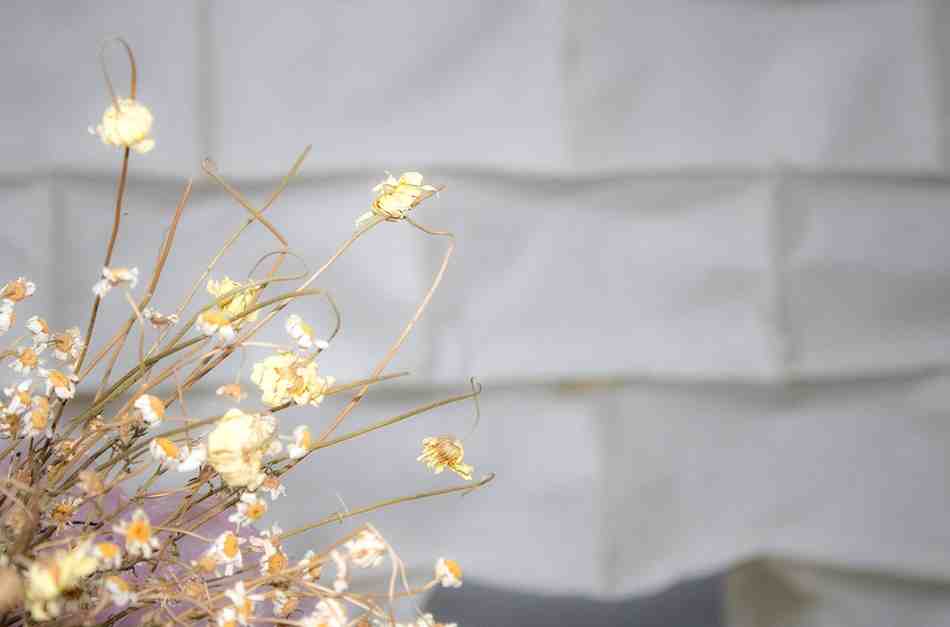
Gabriel Kidd: I found the giant and he was dead
Through sculpture, drawing, sound, and writing, Kidd’s work utilises queer tactics of parody, fluidity and vitality, to explore mythology, ecology and history.
In this exhibition, Kidd’s first institutional solo show, they have created an immersive work of figurative and sound pieces inspired by local folktale, landscape, erosion, and medieval notions of time. Naturally dyed silk (with weeds, wayside trees or healing herbs), whittled pine arrows, poured/cast latex skin and eggs, and Kozo paper architectural forms are painstakingly crafted and stitched together with mass produced sequins or acrylic nails. In a series of vignettes, emotionally suggestive human forms appear in the ruined remains of a hilltop domestic dwelling.
Private moments between figurative sculptures are drawn out through the reimagined folktale of two giants, Alderman and Alphin (from the valley of Greenfield, Saddleworth) who become embroiled in a tale of friendship, love, jealousy, revenge, and loss. Husk-like in their fragility, Kidd’s figures—queer, camp, decaying, putrid, oily, beautiful—commune in indeterminate dialogue. A unifying soundtrack developed in collaboration with organist and composer Willow Swan, creates a disquieting ambience. Church organs, phone recordings of techno music, field recordings of wind, water and rain, come together to underscore the installation as a site of aftermath and memory.
The relationship between interior and exterior worlds is explored throughout the work. Through gestures and signals performed in gay cruising culture, the poised, slouched, or side-lying, the figures invoke a knowing desire, blurring a sense of individuality, empowerment, and destruction. A series of windows, slits and sightlines carved from antique wood suggestive of medieval church squints, surround the gallery walls. Treated with the same fleshy materials as the bodies, they imbue the architecture of the building with the same viscous physical and psychic properties.
Materials, their provenance, cultural, social, and political significances, are important to Kidd, woven into queered perspectives on natural process, religion and gay culture. The work challenges the notions of permanency, monumentality of traditional sculpture, and gender-essentialism. In this work, traditional understandings of sexuality, gender and identity are powerfully subverted through instances of fragility, precarity and not-knowing, finding resilience through transition and the natural evolution of materials.
Nicola Ellis: Exercises in Knowing and Gabriel Kidd: I found the giant and he was dead are curated by Clarissa Corfe.
For additional information, please contact the Press Team via email on press.comms@homemcr.org